
It started when I reached 63. We had been in Broadstairs less than a year. I’d had a very mild tummy pain for a couple of days and Julian urged me to go to the doctor. I thought it was probably an ulcer as I’d had one before. He took me to the doctor and onwards to A&E where I was diagnosed with suspected appendicitis.
Rather than jumping in and opening me up immediately, the doctors at the hospital carried out a few other tests, one of which was a scan of my gall bladder, which can cause pain in the same area, I imagine. The person who scanned me commented that I had lots and lots – and lots….and lots of stones in my gall bladder but there was no sign of inflammation. I don’t know what other tests they did, or at least I don’t remember but, later in the day I was opened up and had my nearly bursting appendix removed. Later I was told that the majority of people with appendicitis are much younger. I was lucky, I guess 😜
The one thing I really remember about the day after the op was a strange hallucination I had when I was in the bathroom. I was sitting there, facing the door when I realised that there were sentences of English words, rather like a wide newspaper column, in yellow and white, scrolling up the door! Sadly, I couldn’t read what the words were but I found the effect most interesting!
That was just the start of my 60s ‘under the knife’! In no particular order, that operation was followed by four others before I reached my 70th year.
I’ll start with my ear. I had been sitting on the couch reading a book when I realised that my right ear felt ‘stopped up’. I waited a few days before going to the doctor as I thought it was something and nothing – it would stop feeling like that in a matter of days. A week or so went by and it hadn’t improved so I saw the doctor who looked in my ear and saw that there wasn’t an immediate cause that he could see, so he referred me to the ENT department of the hospital. I was given an appointment, attended on the day, was given a hearing test which showed that there was some hearing loss in my right ear. (I already knew that!)
I was sent home with a further appointment some months later. My hearing had not improved. The consultant – an older man – decided I should have a grommet inserted into my ear drum. This is what they do with children who have something called “glue ear”. I didn’t think that was what I had at my age, but…. I agreed to have it, not knowing I wouldn’t be allowed to go swimming until it had fallen out. This was a shock as swimming and exercising in water were my main forms of exercise. Under anaesthetic, the grommet was inserted, then I rested for an hour or two before being allowed to go home.
Sadly, I had no change in my hearing but I found a swimming cap that covered my ears well enough for me to get back into the swimming pool. After a year, the grommet fell out.
The last time that I went to the ENT department, there was a much younger consultant. He was astonished that I hadn’t previously had an MRI of my head (or maybe a CAT scan – I don’t quite know the difference!) So, I was given an appointment for the scan, the result of which was…….nothing! I have never heard if they found an acoustic tumour on my acoustic nerve or not – and, today, they’ve no record of that scan as it was so long ago!op

Next, another operation as a day patient but without a general anaesthetic. I had carpal tunnel in both wrists, had all the steroid treatments that I was allowed and came to the day when the pain was too great and the pins and needles were driving me batty!
Julian drove me to the place the op was to be carried out. It was a medical centre, somewhere off the A2 on the way from Thanet to Herne Bay. It was a Saturday and carpal tunnel operations seemed to be the only thing happening there that day. My turn came quite quickly. I sat in front of the doctor whose job it was to make an incision in my hand, near to the wrist. I averted my eyes so that I couldn’t see the blood or the tendons or whatever else I might have seen. It took a very short time to do whatever he needed to do re: the carpal tunnel, then I believe it was stitched up – since I am allergic to nickel I’m fairly certain they didn’t use staples – and my hand was bandaged. Another two weeks of not going swimming!
The most interesting thing about that op was what happened after the op. My left hand was treated but the right hand also stopped having symptoms! The doctor said that that might happen, and that is exactly what did happen! For the next eight to ten years I had no carpal tunnel symptoms in either hand. How does that work? Sadly, I have them again in my right hand but my left hand is still symptom-free!
Now we come to the knees part of my title and, certainly, the biggest ops. I think I’ve mentioned before that I used to help Julian carry big items of furniture into and out of Antique Fairs, hopping up into the back of the van and down again; helping to carry the top half or the bottom half, of a secrétaire bookcase, or crates of ceramics or, once, a beautiful wooden cradle which was full of plants. Anyway, this type of exercise plus all the walking and standing and dancing and climbing stairs and running after children or cats, had a bad effect on my knees. First the right one started clicking, then swelling, then eventually, causing pain which grew in intensity – swiftly followed by the left.
The doc sent me for x-rays which showed that neither knee had much, if any, cartilage left between the bones in my knees and the pain was caused by bone rubbing on bone. (Ouch!) So, I met with an orthopaedic surgeon and it was agreed that I would go onto the waiting list to have both knees replaced – one at a time, of course. In 2010, when I was 67, I was contacted by the hospital to say that my wait would come to an end for my right knee at least, in June.
When you have a knee, or indeed a hip, replaced, the NHS checks to see whether your bed, your chairs and your toilet are the right height for you to use when you get home with a new bandaged joint which can’t bend or lift up as easily as before. Anything you may need is loaned to you. I had a frame which went round the loo with bars on either side to help you heave yourself onto your feet. I also had a walking frame, and a pair of crutches.
Julian was working in those days and was unable to get me to the hospital so I took a taxi early in the morning. For the first knee I was given a room in the private Spencer Wing of the QEQM – not that I was a private patient but, sometimes the hospital borrowed a room if necessary.. I settled into my room in the morning and was taken from there to the operating theatre. I remember having a chat with the anaesthetist before he administered an epidural and a general anaesthetic in an ante room. I must have been wheeled into the operating room and undergone a huge procedure because, when I woke up my knee has been replaced and I had a gigantic(!) bandage on my right leg.
Surprisingly, knee replacement patients are expected to get up and move around within a few hours of the op. I remember having to pee sometime in the night and being made to get out of bed and grab hold of a walking frame to get into the little bathroom, then to make my way back to bed. I doubt if I could have lifted my leg onto the bed on my own, so there must have been a nurse nearby to come to my aid. I also remember being given, by mouth, something the nurse told me was morphine. I wondered to myself if I’d get high, but no such luck! I still felt the pain I had complained about.😖
My stay in the hospital was 4 or 5 days. In that time I had to prove I could negotiate stairs by climbing a set of three steps using crutches – I managed that alright, but the other proof I had to give was more difficult. I had to sit in the bed and lift the bandaged leg while a doctor watched. Somehow, I managed it after 2 or 3 attempts. Finally, I could go home!
Julian came to get me and I walked, with crutches, to the car and sat down, sideways onto the passenger seat with both my feet still on the kerb. I tried to lift my right leg into the car but I couldn’t! I kept trying but no way could I turn and lift! Then, I had a brill idea – Julian went to my bag and found my dressing gown belt. I held onto the ends – one in each hand, and put the resulting loop under my foot which I then lifted and swung into the car. (If you’re having a knee replaced, that is the first thing to remember to pack – some sort of long enough belt!)😄
The healing took time, and everything went well – the district nurse came to take out the stitches, I did the exercises I was given by the physiotherapist, summer came, then autumn and on the first of December, 2010, I entered the QEQM again, for the 2nd knee op.
I wasn’t in a private room this time, but I really didn’t mind. The only difference that I could see was that the food wasn’t quite as good. There were a few other women with bandaged limbs in the ward which housed about 8 beds. On the second day, things were different. Outside, everything was white. The snow fell all day (if I remember correctly.) In all the beds there were patients with broken limbs. Also, there was a lack of nurses, doctors and ancillary staff, all because of the snow!
Nevertheless, things went fairly well. Julian, always intrepid, never let a little snow get in the way of whatever he wanted to do, so he came to visit me in the hospital. The days passed and I did all the physio necessary, climbed the little 3 step stairs and even lifted my left leg high enough that the doctor agreed to let me go home.
The worst thing about my recovery that time was that my body no longer would tolerate the sticky tape they used to keep my bandage in place. My leg itched non-stop. I knew I should not scratch it and was careful not to put my hand anywhere near the bandage but my ankle and shin were also itching and I scratched a bit, I confess. Unhappily, that caused my wound to become infected! It took two lots of antibiotics to kill that infection😩. Even today, nearly 13 years later, my two legs look different. The scar on my right leg is there but almost invisible whereas the scar on my left leg is quite wide because of the swelling when I had the infection. Luckily, I have preferred wearing trousers most of my adult life and seldom wear a skirt or dress.
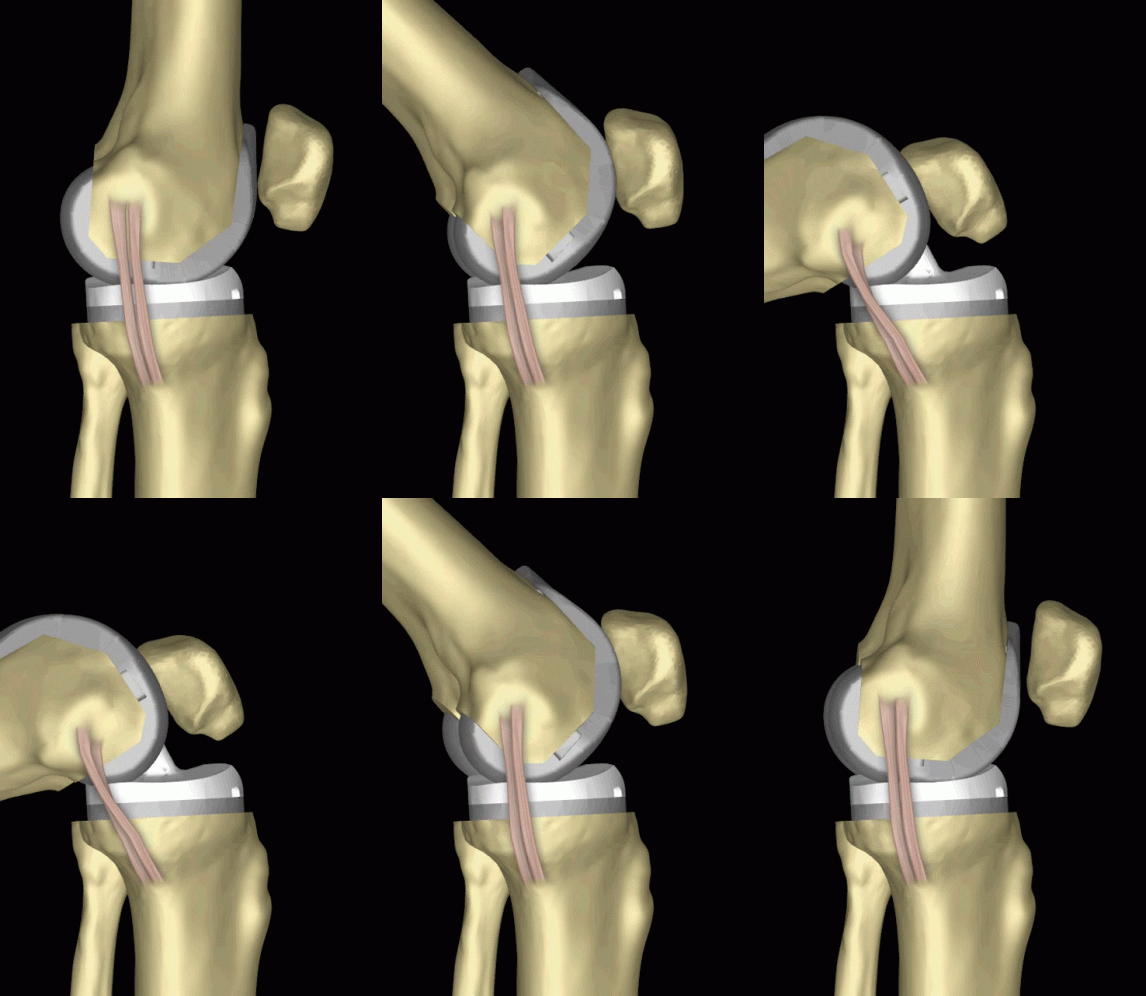
I was told that knee replacements can wear out in ten to fifteen years. I’ve passed the first and am approaching the second. Sometimes my knees feel a bit stiff and occasionally there’s a twinge of pain but I am not going to have any further knee ops if I can possibly help it! For one thing, I tend to sleep on my side and for six or so weeks after the op, it’s impossible to turn on your side – it’s sleep on your back only!
All the above happened when I was young – in my 60s. All through my 70s I kept away from surgeons’ knives, though I had a short stay in hospital with pneumonia, I found that I’m allergic to penicillin, and I found out that sciatica is not a pleasant condition.
I wonder what is in store for me in my 80s!

 White Haired Woman